


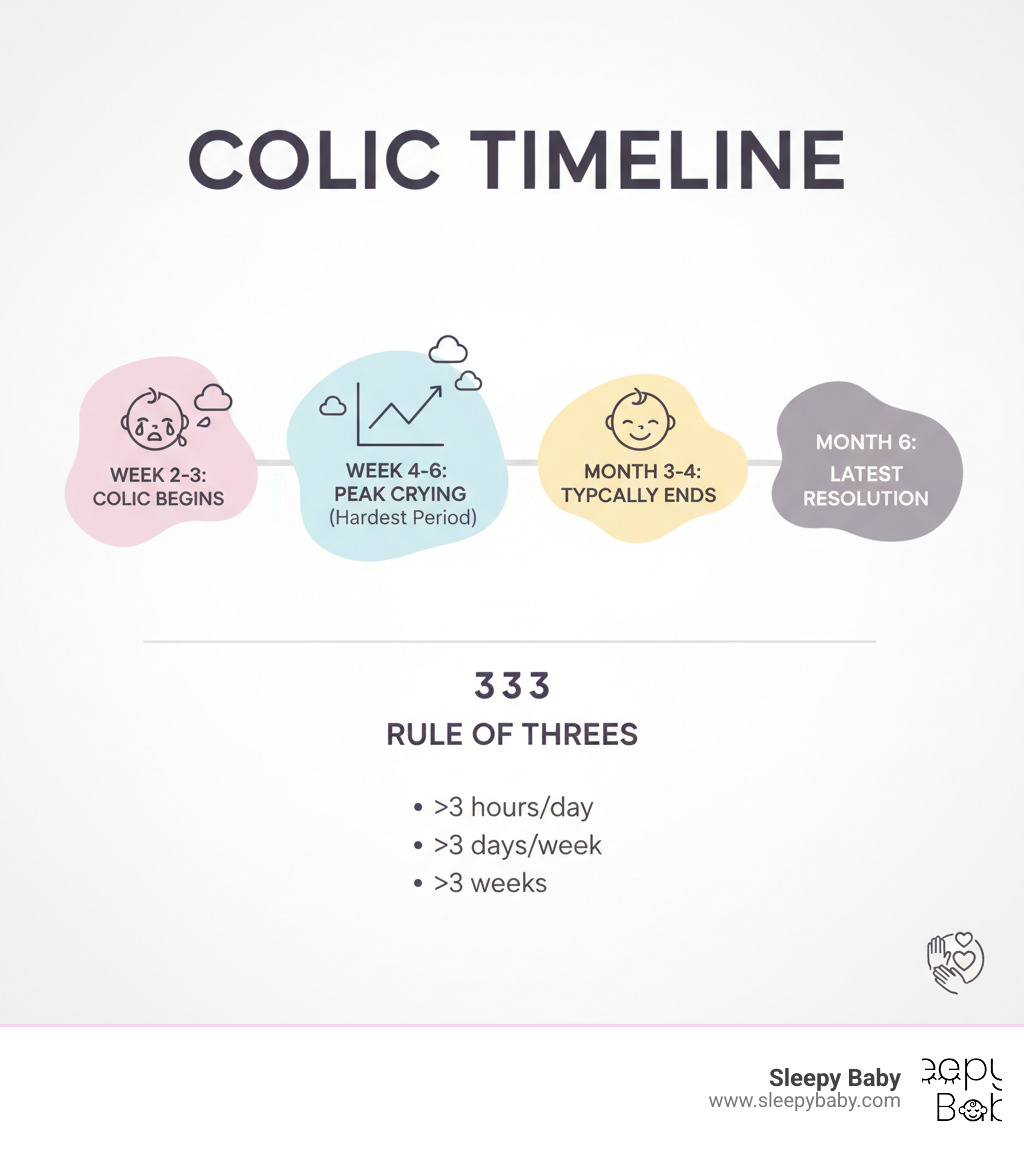
When does colic go away in babies is the urgent question on every exhausted parent's mind. The good news: colic typically resolves on its own by 3 to 4 months of age, though it can occasionally last until 6 months. Here’s the typical colic timeline:
Colic is a challenging phase of early parenthood, affecting about 1 in 4 babies. It involves intense, unexplained crying for hours, often in the evening, leaving parents feeling helpless and exhausted. The crying is louder and more high-pitched than normal fussing. A baby's face might turn red, their fists clench, and their legs curl toward their belly.
If you're in the thick of it, take a deep breath. This phase will end. Colic isn't a reflection of your parenting and doesn't harm your baby's long-term health.
As a father who lived through sleepless nights with a colicky newborn, I understand the desperation. That experience drove me to create solutions to help families find relief during this exhausting phase.
If you're reading this with a screaming baby in your arms, you just want to know when it will end. While every baby is different, colic follows a predictable pattern that offers some reassurance. Colic starts suddenly, worsens, and then often stops just as abruptly. Understanding this timeline can reassure you that there is an end in sight.

Colic often catches parents off guard because it doesn't start right away. The first few weeks may be peaceful, making the sudden crying more jarring.
Most babies develop colic symptoms between 2 to 3 weeks of age. Your newborn might suddenly have crying fits around the same time each day as their digestive and nervous systems mature and they adjust to life outside the womb. If your baby hasn't shown signs of colic by six weeks, you're likely in the clear.
Just when you think you have a handle on things, colic often intensifies. The crying gets louder, longer, and harder to soothe. This isn't your fault.
Colic typically reaches its worst point between 4 to 6 weeks of age. These are the most exhausting weeks. Crying episodes stretch longer, and evening meltdowns feel relentless. Many parents feel they are in survival mode. You are not failing. This is how colic works, and you're doing the right thing by seeking information to help your baby.
So, let's get to the answer: when does colic go away in babies? For most, colic resolves on its own by 3 to 4 months of age.
Remarkably, it can end suddenly. Many parents report the crying just stops one day, as if their baby's system finally matured.
About 90% of babies outgrow colic by 3 to 4 months. For some, it can last until 5 or 6 months old. If crying continues past 4 months, it's worth talking to your pediatrician to rule out other issues, even if it doesn't mean something is wrong.
Spontaneous resolution is a defining feature of colic; it simply runs its course. You and your baby will get through it. We dive deeper into this transition in our article, "Goodbye Colic: Understanding When Your Baby Will Finally Settle".
While you wait for the crying to stop, know you're not alone. Millions of parents have walked this path and made it through. You will too.
Let's define colic. It's more than fussiness; it's a specific, distressing crying pattern. Differentiating it from normal crying or other medical issues is the first step toward finding relief.

Colic is often diagnosed using the "Rule of Threes": an otherwise healthy baby crying for more than 3 hours a day, at least 3 days a week, for more than 3 weeks in a row. Beyond the hours, specific characteristics set a colicky cry apart.
Reassuringly, a colicky baby is otherwise healthy, eating and gaining weight normally. Consult your pediatrician if you notice other symptoms. For a deeper dive, check out "The Crying Game: Recognizing Colic Symptoms in Babies".
The frustrating truth is that the exact cause of colic is unknown. This can be maddening for parents seeking a fix, but you're not alone—researchers are still investigating. However, several theories might help guide management strategies.
None of these theories fully explain colic, which is likely caused by a combination of factors. The Cleveland Clinic provides more on colic causes for further reading. The good news is that regardless of the cause, colic is temporary and will pass.
When your baby is inconsolably crying, finding comfort is your top mission. There's no magic bullet for colic, but a toolkit of soothing methods can help. What works one day might not work the next, so it's good to have several strategies.

Classic techniques often mimic the womb or provide gentle comfort to help babies feel secure.
For more detailed strategies, read "The Ultimate Guide to Soothing a Colicky Baby Without Losing Your Mind".
Beyond traditional methods, innovative products offer much-needed support for parents.
White noise can mimic womb sounds and calm an overstimulated baby. While some machines can be too loud, modern safety-rated devices present white noise at safe, low-decibel levels. Some can even be placed on the baby's chest, delivering sound effectively without being overwhelming.
This brings us to rhythmic tapping devices, where Sleepy Baby's intelligent sleep aids shine. They mimic a caregiver's comforting pat, a motion that is effective but exhausting to do manually. Our devices replicate this natural rhythm to provide hands-free comfort, giving parents a break and promoting independent sleep—a game-changer during the colic phase.
Over-the-counter remedies like gas drops (simethicone) or gripe water are also popular. Gas drops break up gas bubbles, while gripe water is an herbal remedy with limited scientific backing. Always consult your pediatrician before giving your baby any medication or supplement.
Probiotic drops containing strains like Lactobacillus reuteri have shown some promise in reducing crying by balancing gut bacteria. However, research is ongoing. Discuss this option with your pediatrician.
You can explore a range of innovative tools in our guide, "Gadgets to the Rescue: Top Colic Relief Devices for Babies".
Small feeding adjustments can sometimes make a big difference.
While trying these techniques, you're doing everything right. Your job is to comfort your baby as they outgrow this phase.
Caring for a colicky baby is incredibly hard, both physically and emotionally. While your baby's comfort is important, so is yours. You can't pour from an empty cup, so taking care of yourself is essential.
Feeling guilty, frustrated, or angry is normal. The stress of colic can push anyone to their limits. Acknowledging these feelings is the first step to coping.
The stress can trigger or worsen postpartum depression and anxiety. If you feel persistently sad, hopeless, or unable to cope, contact your healthcare provider. Seeking help is a sign of strength. For more strategies, read our article, "Calming Colic Chaos Without Losing Your Mind".
While colic is usually harmless, rule out other medical issues. Trust your instincts; if something feels wrong, call your pediatrician. They would rather you call than worry in silence.
Call your pediatrician immediately if you notice any red flags:
Your pediatrician can perform an exam to rule out other conditions that mimic colic, such as infections, allergies, or reflux. Often, this provides valuable reassurance that your baby is healthy. The Cleveland Clinic offers helpful guidance on when to call the doctor for your newborn.
We've gathered the most common concerns parents have about colic duration and answered them honestly.
No, colic is not harmful to your baby in the long run. Despite the distress it causes, colic is a temporary condition with no lasting impact on health, development, or personality. Colicky babies grow into healthy, happy children.
The outlook is excellent. Colic resolves completely on its own, usually by 3 to 4 months, with no lasting effects. Your baby won't remember this phase. The stress falls on the caregivers, which is why self-care is so important.
If your baby still has colic at 4 months, you're not alone. While most colic ends by 3-4 months, it can last until 5 or 6 months in some healthy babies. If your baby is otherwise thriving (eating well, gaining weight), this extended timeline is usually not a cause for alarm. However, it's wise to consult your pediatrician if crying continues past 4 months. They can rule out other causes like reflux or food sensitivities and offer peace of mind and additional coping strategies.
If you're in the middle of another colicky night, we see you. We know it can feel like an endless tunnel. The question of when does colic go away in babies is a lifeline.
Hold onto this truth: colic is a phase, not forever. For most babies, it ends by 3 to 4 months, often abruptly. The crying will stop, and peaceful nights will return, becoming more than just a distant memory.
Until then, your best tools are patience and self-care. We know it's hard on little sleep, but remember: you are doing a great job. Your baby isn't crying because of anything you've done; they're just struggling to adjust to the world.
The crying will stop. Peaceful moments, smiles, and giggles will replace it. Soon, those sleepless nights will fade into the background as you enjoy watching your baby thrive.
In the meantime, lean on your support system for breaks. It's okay to put your baby down safely and step away for a moment. Know that we're here to help with solutions for these tough times.
Ready to explore tools that can bring some calm to the chaos? Discover more colic relief devices for babies and find the support you both deserve. You're not alone in this journey, and the light at the end of the tunnel is closer than you think.


