


6 month old early waking is one of the most exhausting challenges new parents face. If your baby is consistently waking before 6:00 AM and refusing to go back to sleep, you're dealing with a solvable problem. Here's what you need to know:
Quick Solutions for 6 Month Old Early Waking:
Just as you start getting more sleep, your 6-month-old suddenly starts waking at 5:00 AM, ready to start the day. Early waking means any consistent wake-up before 6:00 AM that your baby treats as the start of their day. While a wake-up between 6:00 and 7:00 AM is biologically normal, an alert baby at 4:30 or 5:00 AM means something in their sleep puzzle needs adjusting.
The good news is that this is one of the most fixable sleep issues at 6 months. The solution usually lies in your baby's daily schedule, their sleep environment, and how you respond to those pre-dawn wake-ups.
As a father who created Sleepy Baby after my own newborn's sleep challenges, I learned that solving sleep issues requires a systematic approach, which this guide provides.
6 month old early waking helpful reading:
To fix 6 month old early waking, you first need to understand what normal sleep looks like at this age. Your 6-month-old needs about 14 hours of total sleep in a 24-hour period. This typically breaks down into 11-12 hours at night and the rest in daytime naps. The American Academy of Pediatrics confirms these numbers, so if your baby is getting significantly less, adjustments are needed.
At 6 months, most babies are on a 3-nap schedule, staying awake for 2-3 hours between sleep periods (wake windows). The first wake window is usually shortest, lengthening as the day progresses. The first two naps are often longer (60-90 minutes), with a shorter catnap in the late afternoon.
Getting this schedule right is crucial. Too much daytime sleep means they won't need a full night's rest. Not enough daytime sleep leads to overtiredness, which paradoxically worsens early waking.
At this age, your baby's circadian rhythm is maturing, syncing with the day-night cycle. This makes them more vulnerable to waking between 4:00 and 6:00 AM, when sleep is naturally lighter. During this window, melatonin (the sleep hormone) drops and cortisol (the wake-up hormone) rises. Any small disruption—a noise, a sliver of light—can cause a full wake-up, and it's much harder for them to fall back asleep.
This is why 6 month old early waking is so common. Your baby's sleep is maturing, but the process has some growing pains. For a complete breakdown of schedules, check out our guide: Sweet Dreams Ahead: Mastering the 6-Month-Old Sleep Schedule.
Understanding why your 6 month old early waking is happening is the first step to fixing it. Let's explore the common culprits.

Both too much and too little sleep can cause early waking. It's a common reason for 6 month old early waking.
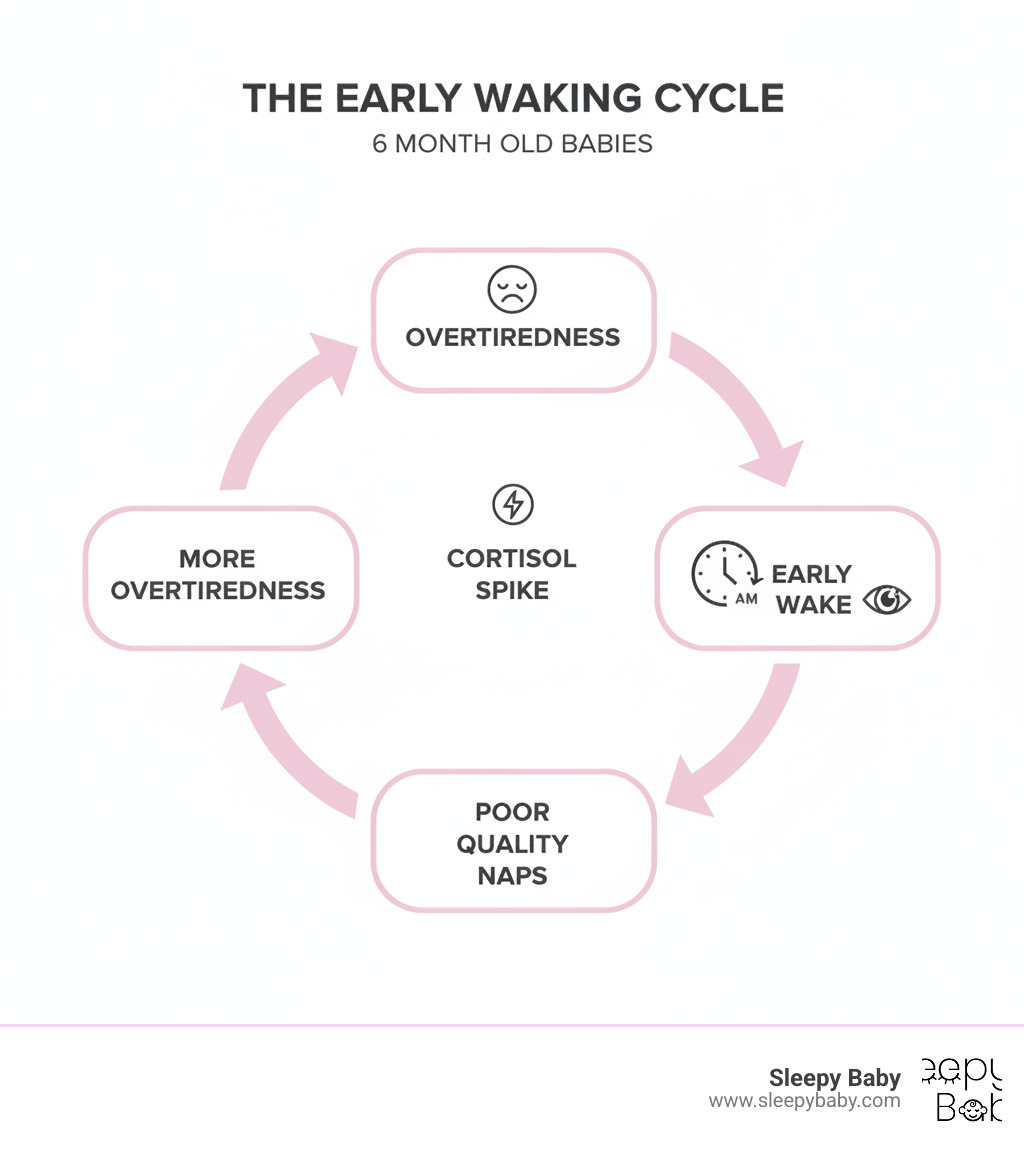
An overtired baby's body produces cortisol, a stress hormone that acts like an espresso shot, leading to lighter sleep and earlier waking. This is why a later bedtime often backfires. Signs of an overtired baby include constant eye-rubbing, fussiness, short naps, and frequent night waking.
An undertired baby hasn't built up enough "sleep pressure" to last the night, often due to too much daytime sleep or a late nap. Signs include resisting naps, playing in the crib instead of sleeping, and waking early but seeming cheerful.
Your 6-month-old is hitting major milestones like rolling, sitting up, and babbling. While exciting, this can wreak havoc on sleep. Their brain is so excited about these new skills that they may practice them in the crib, even in the early morning hours, making it hard to go back to sleep.
This period also coincides with maturing sleep cycles. As they transition between light and deep sleep, it's easier to wake fully in the early morning. While not every baby has a dramatic "regression," many parents notice sleep disruptions. Learn more in our guide on 6-Month Sleep Regression: Signs Every Parent Should Know.
Your baby's nap schedule directly impacts early waking. The first nap of the day is a major factor. If it's too early (before 8:30 AM), it can reinforce the early wake-up. This creates a cycle: they wake early, get tired early, nap early, and repeat.
Similarly, the last nap of the day can be a problem. A nap that ends after 3:00 PM can reduce the "sleep pressure" needed for a full night's sleep, resulting in early waking. Transitioning from four short naps to three longer ones is also key, as too many naps can lead to an undertired baby at bedtime. We cover this in Six Months, Three Naps, One Happy Baby.
Sometimes the culprit is the sleep environment. During the light sleep of the early morning, even tiny disturbances can wake your baby.
Is your baby genuinely hungry, or is this just a habit? At 6 months, some babies still need a night feed. If your baby takes a full feed and goes back to sleep easily, it's likely genuine hunger. Always consult your pediatrician about your baby's nutritional needs.
However, if they're growing well and only take a small, comforting feed before struggling to resettle, the wake-up is likely habitual. The solution is different for each scenario. Our guide Midnight Snacks? No More! Your Guide to 6-Month-Old Night Feeding can help you determine the right approach.
Now that you know the 'why,' here's the 'how.' These steps will help you create the routine and environment for sleeping later.

This is often the most impactful change. It might sound counterintuitive, but an earlier bedtime can fix early waking. Overtiredness causes a cortisol spike that acts like an alarm clock, and an earlier bedtime (often between 7:00-8:00 PM) breaks this cycle.
Properly timing naps is also crucial:
Consistency is key. A predictable schedule for naps, meals, and bedtime helps regulate your baby's internal clock and teaches them the new, later-morning routine.
Your baby's room environment can be the difference between a 5:00 AM and 6:30 AM wake-up.
All of this must happen within safe sleep guidelines. Always place your baby on their back on a firm, flat surface, free from loose bedding or soft toys. For comprehensive guidance, consult the American Academy of Pediatrics.
Your response to early wake-ups can either reinforce the habit or break it. The golden rule: treat any wake-up before 6:00 AM like the middle of the night. Keep interactions minimal, dark, and boring to send the message that it's not morning yet.
Before rushing in, try the "wait-and-see" approach. Give your baby 5-10 minutes to see if they can resettle on their own. This gives them a chance to practice self-soothing skills. If they are truly distressed, of course you should respond.
If you're still struggling with 6 month old early waking after a couple of weeks of consistency, formal sleep training can be an appropriate option. Gentle methods can empower your baby to fall back asleep independently. Find the right approach for your family in our guide: Dream Team: Effective Sleep Training Methods for 6-Month-Old Babies.
Let's address some common concerns about 6 month old early waking.

It depends on the cause. If it's a developmental leap, it may resolve in a few weeks. If it's a schedule or environment issue, you should see improvement within one to two weeks of consistent changes. Your baby's internal clock needs time to adjust, so consistency is crucial. If you see no progress after 2-3 weeks of consistent effort, consult your pediatrician to rule out medical issues, or a sleep consultant for personalized advice.
Your baby's daytime behavior is the best indicator. A well-rested baby is generally happy, has a good appetite, and is meeting developmental milestones. They won't seem constantly cranky or overtired between naps. Conversely, constant eye-rubbing, irritability, and meltdowns are red flags that they aren't getting the quality rest they need, even if the total hours seem sufficient.
Yes, a consistent 5:00 AM wake-up is considered too early and is worth addressing. Biologically, a wake-up time between 6:00 AM and 7:00 AM is normal for babies. If your baby wakes happily at 6:15 AM, they may just be an early bird. However, a 5:00 AM wake-up usually signals a fixable issue in their schedule, environment, or sleep associations. Before resigning yourself to pre-dawn mornings, try these strategies. In most cases, you can shift that wake-up to a much more manageable 6:00 or 6:30 AM.
You now have the tools to fix your 6 month old early waking and shift those wake-ups to a more reasonable hour. The path forward is built on three pillars: a consistent, age-appropriate schedule; a dark, quiet sleep environment; and a calm response that treats any wake-up before 6:00 AM as nighttime.
Patience and consistency are your most powerful tools. It can take one to two weeks to see meaningful improvement, so stick with your approach even when it feels discouraging.
At Sleepy Baby, we've been there. That's why we designed our intelligent sleep aids. They combine rhythmic patting that mimics your touch with safe, low-decibel white noise. This helps babies connect sleep cycles during those light, early-morning hours, encouraging the independent sleep skills needed to resettle themselves at 5:00 AM.

Every family deserves peaceful mornings and restorative sleep. With these strategies, better mornings are within reach.
Explore our blog for more expert sleep tips covering everything from developmental regressions to perfecting your bedtime routine.


