


If you're wondering how to help fussy baby sleep, you're not alone. Many parents face the challenge of a baby who won't settle down, crying just as it's time for bed. It's even more frustrating when they fall asleep in your arms, only to wake up sobbing the moment you lay them in the crib.
To immediately soothe a fussy baby, try these steps:
Babies cry to communicate, and understanding why your little one is fussy is the first step toward finding peace for both of you. This guide offers proven strategies to bring comfort and rest to your family.
Understanding why your baby is fussy, especially as bedtime approaches, is the first step to learning how to help fussy baby sleep. Their cries are their way of telling you something is wrong. Common reasons for fussiness include:
The "witching hour" is a common term for a period of intense, inconsolable fussiness in the late afternoon or evening, usually between 5 p.m. and 11 p.m. This phase often starts around 2-3 weeks, peaks at 6 weeks, and is a normal developmental stage. During this time, babies may also cluster feed, or want to nurse very frequently. This can be due to growth spurts or a natural dip in evening milk supply. The good news is that the witching hour typically improves by 3 to 4 months.
Learning your baby's unique cries is a superpower. Here are some common types:
Keeping a simple log of your baby's sleep, feeding, and crying patterns can provide valuable insights. For more details, read our guide on Why Your Baby Won't Stop Crying.
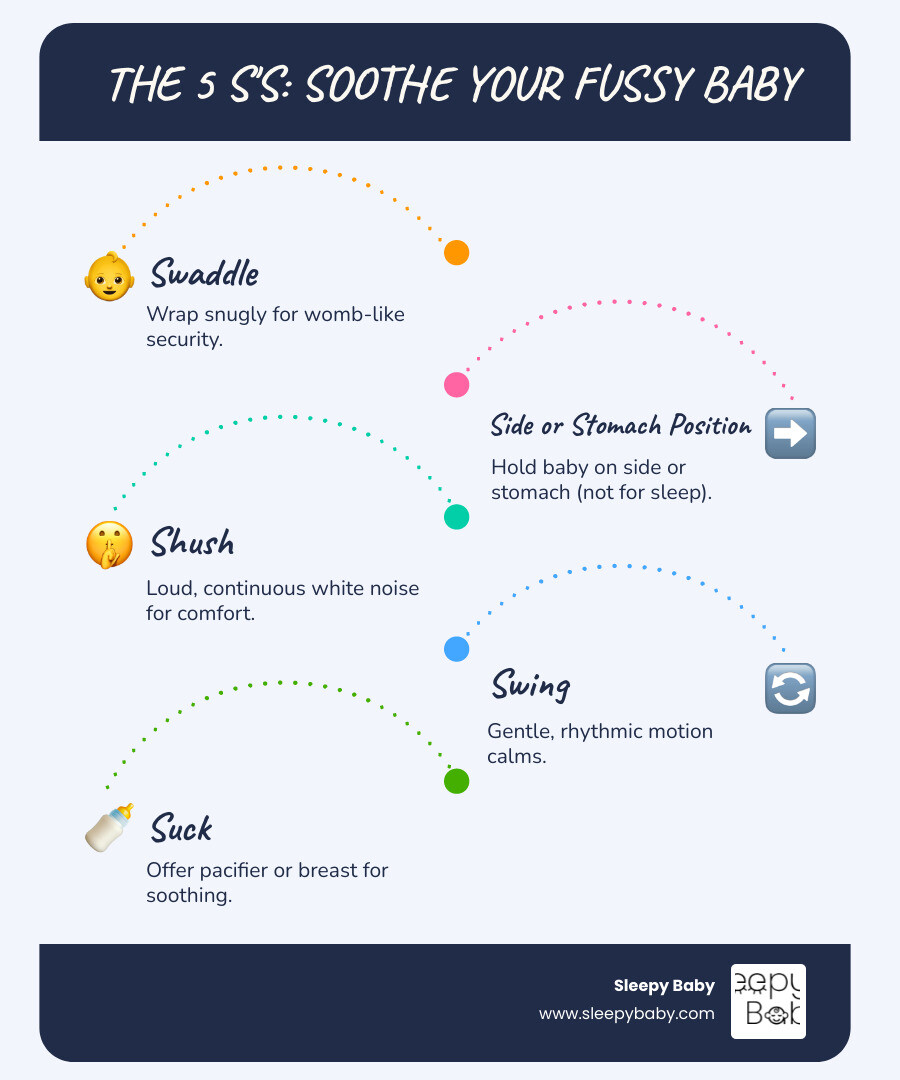
When you need to help fussy baby sleep, a simple, science-backed method can be a game-changer. The "5 S's" method, developed by Dr. Harvey Karp, works by activating your baby's natural "calming reflex," making them feel like they're back in the cozy, comforting womb.

The 5 S's are a powerful set of tools: Swaddle, Side or Stomach Position, Shush, Swing, and Suck. When used correctly, these techniques can often transform a crying baby into a calm, sleepy one. The following sections break down each "S" to show you how it can help fussy baby sleep and find out more about how you can achieve No More Tears Easy Techniques To Help Your Baby Self Soothe.
Swaddling is the first and most crucial "S." Think of it as a warm, secure hug that recreates the snug feeling of the womb. The magic of swaddling is that it prevents your baby's natural startle reflex (Moro reflex) from jolting them awake.

To help fussy baby sleep with a swaddle, wrap them like a "mini burrito" with their arms snug at their sides. Importantly, their hips must remain loose to allow for healthy development. This is called hip-safe swaddling. The wrap should be secure but never too tight around the chest, and their head should never be covered.
For detailed instructions, you can review Safe swaddling practices from pediatric experts. Remember to stop swaddling once your baby shows signs of being able to roll over, typically around 2-4 months, as it becomes a safety hazard.
We're all taught that "back is best for sleep," and that is absolutely true for unsupervised sleep. However, when you're actively trying to help fussy baby sleep, holding them in the side or stomach position can be a powerful soothing tool.
While holding your baby, you can gently place them on their side (the left side can be especially helpful for digestion) or tummy, always supporting their head and neck. This position is fantastic for calming a crying baby.
Crucially, this position is only for soothing while your baby is awake and in your arms. As soon as your baby is calm and drowsy, you must gently transition them to their back in a safe sleep space, like an empty crib or bassinet. This practice significantly reduces the risk of SIDS. For more information, always follow Safe sleep guidelines.
For nine months, your baby lived in a surprisingly loud environment filled with the whoosh of blood flow and your heartbeat. Complete silence can feel unsettling to them. This is why shushing is one of the most effective ways to help fussy baby sleep.
The secret is to shush loudly—at least as loud as your baby's cries—and then gradually quiet down as they calm. This loud, consistent "shhh" mimics the rumbly, constant noise of the womb. You can learn more in our guide on Womb Heartbeat White Noise Your Baby's Favorite Soundtrack.
Rumbly sounds work much better than hissy sounds like fans. Since you can't shush all night, white noise machines are a great tool. While some older machines may have safety concerns, modern safety-rated devices are designed to present white noise at safe, low-decibel levels. Some innovative portable sound machines can even be placed on the baby's chest, bringing that comforting sound right where they need it most. Always ensure any device meets current white noise machine safety standards.
Your baby was in constant motion in the womb, so recreating this sensation can work wonders to help fussy baby sleep. The key is not big movements, but small, rhythmic ones. For a crying baby, use fast, tiny motions—what Dr. Karp calls the "Jell-O head jiggle"—always supporting your baby's head and neck.
Science backs this up. A Japanese research on carrying babies found that infants' heart rates slowed and they often fell asleep within five minutes of being carried by a walking mother.
Beyond your arms, car rides and stroller walks provide this same soothing motion. For hands-free help, rhythmic tapping devices are incredibly beneficial. These innovative sleep aids mimic a caregiver's comforting pat with consistent, gentle rhythm. Unlike traditional swings, these portable devices provide crucial rhythmic stimulation while allowing your baby to remain in their safe sleep space, helping them calm down and promoting sleep.
Sucking is a powerful calming tool for babies. When they suck, their bodies release calming chemicals called endorphins, which act as natural mood boosters. This non-nutritive sucking isn't about food; it's about comfort.
You can offer a pacifier, their own thumb or fingers, or the breast for comfort. For many babies, this final "S" is the last piece of the puzzle needed to help fussy baby sleep and settle into a peaceful state.
For breastfeeding parents, it's often recommended to wait until breastfeeding is well-established (usually a few weeks) before introducing a pacifier to prevent any potential nipple confusion.
While the 5 S's are great for in-the-moment soothing, establishing healthy long-term habits is key. This involves creating a consistent routine and an ideal sleep environment to help your baby develop self-soothing skills.

For more on building successful habits, check out Routine Magic Creating A Newborn Schedule For Success.
A predictable bedtime routine signals to your baby that it's time to wind down. Start before your baby gets overtired. A simple routine might include a warm bath, gentle massage, feeding, and quiet time with a story or lullabies. To avoid a feed-to-sleep association, try feeding at the beginning of the routine. Finally, turn on a soothing sound machine or rhythmic tapping device and place your baby in their crib when they are drowsy but still awake. For age-specific tips, see Goodnight Sleep Tight Bedtime Routines For Your 3 Month Old.
Your baby's room plays a huge role in their sleep quality.
Sleep regressions are temporary periods when a baby who was sleeping well suddenly starts waking frequently. They often occur around 4, 6, and 8-10 months and are tied to major developmental milestones. The best approach is to stick to your routine and offer extra comfort. Your consistency will help them get back on track. Learn more about the 4 Month Sleep Regression SOS Your Guide To Better Baby Sleep.
Trying to help fussy baby sleep can be exhausting. Studies show new parents lose significant sleep, and persistent crying can increase the risk of postpartum depression. It's normal to feel overwhelmed. Prioritizing your own well-being is essential. For more insights, see our guide on Understanding Why Babies Fight Sleep And How To Help.
While most fussiness is a normal phase, trust your parental instincts. Contact your pediatrician if you notice:
While less than 5% of colic has a medical cause, it's always best to consult a doctor to rule out underlying issues and get peace of mind. They can also connect you with lactation or sleep consultants.
You cannot pour from an empty cup. Taking care of yourself is a necessity, not a luxury.
This challenging phase will pass. Seeking support is a sign of strength.
All babies cry—it's their primary form of communication. In the first six months, it's normal for a baby to cry anywhere from 45 minutes to two hours total each day. If crying lasts more than three hours a day, it might be colic, which typically peaks around six to eight weeks old and then improves. For more on this topic, see our guide on When Does Colic Go Away.
No, you absolutely cannot spoil a baby by holding them too much, especially in the first six months. After nine months of being constantly held in the womb, they need physical contact to feel safe and secure. Responding to your baby's needs for comfort builds a strong, trusting bond and is crucial for healthy development. Learn more about Responding to baby's cues.
This is the question on every parent's mind! For a baby, "sleeping through the night" usually means a continuous stretch of five to six hours. Newborns need to eat every two to four hours, so frequent wake-ups are normal. Many babies start sleeping for a five to six-hour stretch around two to three months of age. By six months old, many are capable of sleeping for 10 to 12 hours without a feeding. Every baby is different, so always talk to your pediatrician about your child's specific needs. Explore this topic further in Opening The Mystery: When Do Babies Sleep Through The Night.
Navigating the journey with a fussy baby is overwhelming, but we hope this guide has provided practical strategies to help fussy baby sleep and bring more peace to your family.
Remember the power of the 5 S's—Swaddle, Side/Stomach Position (for soothing only), Shush, Swing, and Suck. These techniques tap into your baby's calming reflex. Combine them with a consistent bedtime routine and a safe, soothing sleep environment to set the stage for peaceful nights. Be patient and flexible, especially during sleep regressions.
Most importantly, prioritize your own well-being. It's essential to ask for help and take a break when you need it. This challenging phase is temporary. With patience, consistency, and the right tools, you and your baby will find your rhythm.
Here at Sleepy Baby, we understand these moments. Our portable, intelligent sleep aids are designed to mimic a caregiver’s comforting touch with gentle rhythmic patting and soothing white noise. This provides hands-free soothing for your baby, promoting better sleep and giving you a much-needed moment to recharge.
For more expert sleep tips and resources, we invite you to Explore more expert sleep tips on our blog. You've got this, and we're here to help.


